
Not every aphid is the same
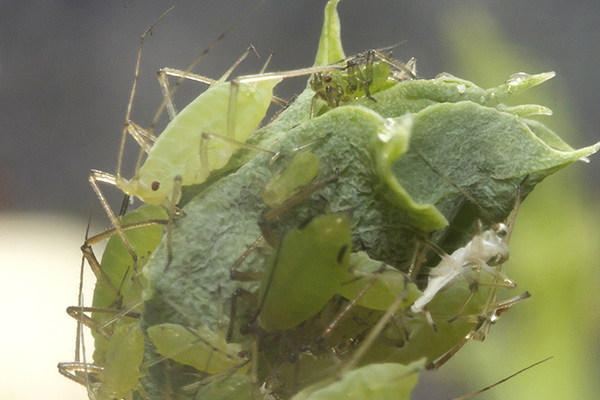
The aphids I bought as ´pea aphids.´
One of the species I would really like to add to the Development project for a while now, is a ladybug. A few years ago, I attempted to follow their growth and development, but I ran into all kinds of problems; a lens that couldn’t magnify enough and escaping aphids. Later, I encountered the same problems with other series and found suitable solutions, so this year I wanted to give it another try. It turned out that caring for ladybug larvae isn’t as easy as it seems.
Which food?
In the last couple of years, I haven’t seen any ladybug eggs in my garden, so I decided to contact a few online stores that sell larvae for biological pest control. One of them was really kind and sent me some eggs immediately. I´d already started some preparations, because it´s important to have enough food for the larvae. I wasn’t convinced that I would be able to find enough aphids in my garden (ladybug larvae can be very voracious, so I knew I needed a lot of food), so I needed back-up. Reptile stores sell ‘pea aphid’ to feed to poison dart frogs; that could be a good solution. My local pet shop, where I normally buy insects for my geckos, didn’t have them in stock, so I ordered them online.
Cultivating pea plants
Because I needed to keep the aphid culture going, I started cultivating pea plants as food for the aphids. This is very easy; you buy a box of dried peas in the supermarket. If you leave them to soak for a couple of hours, they will almost immediately germinate and grow into little pea plants for the aphids to feed on. When the eggs arrived, I felt I was well prepared; I had multiple containers with pea aphids and pea cultures, and also a container with some aphids I found in my garden, just in case. After a few days, the eggs hatched, and quickly I discovered the first problem. I’ve put the larvae in a Fauna box, which I´d secured with a double layer of very fine mesh. But it turned out that the larvae discovered a way to climb out through the mesh anyway. Fortunately, I was able to put the majority back in the box, but I had to find a solution quickly, before they were all gone. I found some old fruit fly containers, with mesh with really small holes. I turned these into ladybug larvae enclosures and put some aphids in as food. In most containers, I put the pea aphids I bought, but I also prepared a container with aphids from my garden.
Are pea aphids poisonous?
After a day or so, I started to notice that I couldn’t see as many larvae as before. Were they still escaping, or did something kill them? I was afraid the ladybug series was going to fail again, but fortunately, there was one container where I could find a few larvae. This was the container with the native aphids. The pea aphids I bought were quite a bit bigger than the native aphids, so could they be too big for the still tiny larvae? In the last couple of days, the aphid culture from my garden was shrinking very fast, and the larvae started to look for more food very actively. I went to look for some more aphids in my garden, but couldn’t find more than a few. So I decided to put one of the larvae in a container with pea aphids. It had grown quite a bit, so maybe the pea aphids weren’t too big anymore. Within a few minutes, the larvae had caught their first pea aphid and started to eat it. Then something strange happened; instead of looking for a new aphid to eat, the larvae stayed in the same place. A few hours later, it was clear to me that it had died. The only conclusion I can draw from this, is that ‘pea aphids’ are poisonous to larvae of this ladybug species. I have no idea why, and I wonder if there is any information available, because not a lot of people will use these aphids to feed ladybug larvae. Of course , I will try to find out more about this, and if I do, I will write a blog about it.
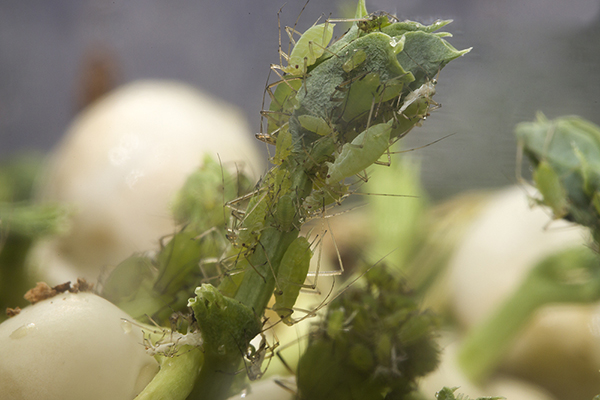
Aphids on a pea plant


Leave a Reply
Want to join the discussion?Feel free to contribute!